The first is arithmetic. If you already pay for bay time, a membership, or lessons, a build offsets a number you are probably not counting — and we will show you the published rates rather than ask you to take our word for it.
The second is that it stops being a golf room about a week in. Which is the answer to the conversation you are actually about to have at your kitchen table.
Free & confidential · No obligation · Takes about 2 minutes
Published third-party rates, not our numbers. Every figure names where it came from.
| What you pay now | Published range |
|---|---|
| Simulator bay, per hour | $20 – $80MyGolfSpy pricing survey · charged per bay, not per golfer |
| Simulator venue membership | $200 – $300 / moMyGolfSpy · Neighborhood National |
| Private lesson, per hour | $50 – $150TeachMe.To · $300+ with a top PGA professional |
| Private club initiation | Over $125,000GGA Partners · at 13% of surveyed clubs; dues up 6.2% year on year |
Sources: MyGolfSpy simulator pricing survey, Neighborhood National simulator club pricing, TeachMe.To lesson pricing, and GGA Partners club initiation data. These are rates published by third parties for what off-course golf costs today. They are not Golfspedia estimates, and nothing here is a quote.
$7,800
A year. Three hours a week at $50 an hour — near the middle of the published bay range, and roughly one evening and one weekend session.
Add a $250-a-month membership and that is $3,000 more, plus the drive and whatever the booking window does to your Saturday. Twelve lessons at $100 is another$1,200.
A $20,000 build set against $3,000 to $8,000 a year of that spend is roughly athree to six year payback — and unlike the membership, the room stays when you stop paying for it.
The screen, the projector and the tracking hardware were never golf-specific to begin with.
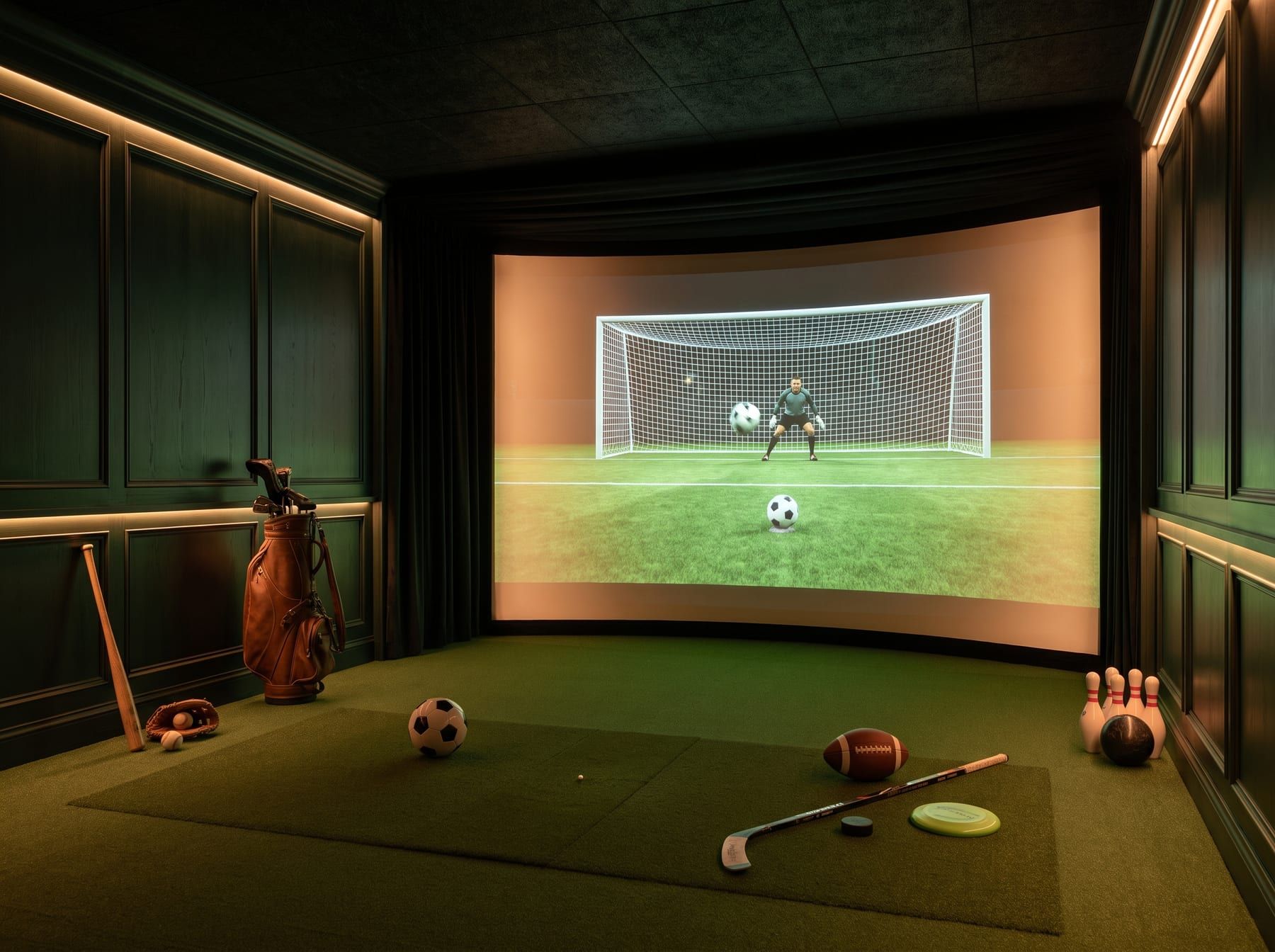
The tracking hardware reads a hockey puck, a football and a soccer ball much as it reads a golf ball. Depending on the system you choose, the same room runs football, baseball, hockey, soccer, basketball, lacrosse, bocce, foot golf, dodgeball and arcade target games — most of them multiplayer, most playable by an eight-year-old and a scratch golfer in the same session.
You are already installing a large screen, a projector and a dark seated room. Media and console playback is a marginal addition to that build rather than a second project, and integrators do it routinely — the same room takes Sunday golf and Friday movie night.
Difficulty settings and distance boosts exist so nobody gets embarrassed, and the commercial version of this format seats groups of eight. It is the answer to the conversation you are about to have at the kitchen table about what happens to the basement.
No tee time, no drive, no daylight, no January. Simulators grew out of the pro training bay and into a mainstream category because they turn golf into something you do after dinner instead of something that costs you a Saturday.
The format is multiplayer and spectator-friendly by design, which is exactly why commercial venues sell bays to groups rather than to individuals. It is also the practical replacement for the client entertaining that used to require a club membership.
Specify a retractable screen and a movable hitting mat at design time and the space reverts to a theater, a gym or a guest room without demolition. That is worth deciding early rather than discovering later, and it is the difference between finishing a basement and finishing a basement for exactly one person.
Almost every dealer blog claims a simulator adds resale value. Almost none of it is sourced, and the trade itself says close to the opposite: appraisers generally do not treat a simulator as an added-value feature, and a single-purpose golf room can narrow your buyer pool rather than widen it — a buyer who has to pay to undo the space is a buyer bidding lower.
What does add value is the finished square footage. Turning unfinished basement or garage into a proper conditioned room is a real improvement regardless of what goes into it. Build it so it converts back, and you get that upside without carrying the risk.
We would rather tell you that than sell you a number we cannot support. If an installer quotes you a resale figure, ask them where it came from.
Both affect what multi-sport costs, and both are cheaper to ask about than to retrofit.
Not all of them do, and this single answer decides whether multi-sport is available to you at all. Ask before you compare quotes, not after — it can change which system is on the table.
Higher-speed objects need a reinforced screen. It is a real line item rather than a checkbox, and a screen specified for golf alone is not the one you want a slap shot hitting.
No cost, no obligation, and your details go to one company — not a list.
The room matters more than the equipment — it's most of what an installer needs to know.
Free & confidential · No obligation · Your details go to one installer
Answer a few questions about your space and we'll show you what a build like yours runs, then introduce you to one vetted installer covering your area.